Showing posts with label Peshwah. Show all posts

Thursday, August 15, 2024

DA3 City of the Gods (TSR, 1987)


While it would later be revisited in the d20 version City of the Gods for the Dave Arneson's Blackmoor line, the legendary City of the Gods from Dave Arneson's original campaign had been whispered about since it had been mentioned in the First Fantasy Campaign (1977) or perhaps even earlier as a place where many of the original Blackmoor players would see their characters meeting their doom. Even Rob Kuntz and Gary Gygax had struggled to face the dangers of this place.


But it was DA3 City of the Gods that would first give full details about the City and its surrounding Valley of the Ancients. TSR and Dave Arneson had seeming overcome some of their differences and the DA series allowed fans to finally learn more about the world of Blackmoor. TSR partnered up Dave Arneson with freelancer Dave Ritchie who authored the modules based on manuscrips provided by Dave who also gave his final approval on DA1-3. Both Arneson and Ritchie were credited on these three modules, unlike DA4 Duchy of Ten which is only credited to Ritchie while still clearly based on details from Arneson. 


This adventure also gave the world more details about the Peshwah Horsemen and their lands, including expanding the Blackmoor world map south for the first time. Early on in the adventure, the PCs are introduced to Bosero, the character originally played by Jon Sider, before they are soon attacked by things that can only be linked to the City of the Gods. Although the module's excellent cover by Doug Chaffee does not really reflect the contents of the adventure, the shameless use of science fiction on a fantasy adventure module, told customers that Blackmoor is a very different place than what you can expect from most Dungeons & Dragons campaign. Indeed, combining sci fi and fantasy elements was one of the hallmarks of Dave's original campaign and could be seen as early as in Supplement II's Temple of the Frog. Zeitgeist Games would later double down on sci fi in Blackmoor campaigns with Clock & Steam decades later.


Item Code: #9191 (DA3)
Title: City of the Gods
Type: Adventure
Author: Dave L. Arneson and David J. Ritchie
Published: 1987
Format: 48-page book w/tri-fold cover, fold-out map


"New Magic... That's what the flying egg has. New magic unlike any ever encountered in Blackmoor. New magic of a type that could give the fledgling kingdom an important edge in the wars that are brewing on its borders. There are only a few minor problems. Like the fact that the magician who piloted the metal egg to one of Blackmoor's southern outposts was killed before he could utter a word. And the fact that Blackmoor's sworn enemies, the monks of the evil and eccentric Order of the Frog, are also interested in the magic represented by the egg. And, most important, the fact that the egg came from the distant and dangerous City of the Gods. Set amidst the blistered salt flats of the Valley of the Ancients, the City of the Gods is a strange and deadly metal metropolis whose powerful guardians do not welcome intruders. Yet it is to this place of deadly menace that Blackmoor's leaders now send a daring expedition - to bargain for aid in the coming wars - or to steal the magic of the gods."


Have you played this adventure or do you own a copy? I would love to hear your thoughts!

-Havard

Wednesday, July 24, 2024

Riders of Hak (2007) for Dave Arneson's Blackmoor


Riders of Hak 
A sourcebook for Dave Arneson's Blackmoor 


Riders of Hak details the human culture known as the Peshwah. The Peshwah are an important nation living near the Kingdom of Blackmoor in Dave Arneson's campaign setting. I have always been fascinated with the Peshwah. In the First Fantasy Campaign, this group of horsemen were referred to simply as nomads, while the DA modules used the name Peshwah and DA3 The City of the Gods gave much additional detail on these tribes.  I also wrote about the Peshwah tribes in this article


Looking back at this book now in 2024, my favorite parts of the book are definitely the expansions on Peshwah culture and their history in Dave Arneson's Blackmoor setting. Like many of the books in this series and other D&D products at the time, I feel that they suffer a bit from the idea that every 3rd Edition sourcebook needed to include a number of new feats, prestigue classes and the like. While having such rules definitely can be useful for fans running a 3E game in Blackmoor, it does some times come at the expense of other things that I would have liked to see more of in the book. 

Here is a review at The Comeback Inn that I wrote some years ago


The Back Cover reads: 

Children of the horsegod Hak, the Peshwah believe they are a chosen people. Birthed to protect Hak's sacred lands and guide Hak's sacred horses, they are brothers and sisters of his divine spirit, and feel they hold a particular destiny and a special place in this, their land. From the rocky peaks of the High Hak to the dusty floor of the Valley of the Ancients, the tribes of the Peshwah roam. Horseman, nomad, prophet, merchant, warrior... each is a face of the Peshwah. Welcome to Riders of Hak, the definitive sourcebook on the Peshwah for Dave Arneson


Written By: David Brainard and Tad Kilgore. With additional material by C.A.Suleiman. 
Format: Softcover, PDF 
Publisher: Code Monkey Publishing / Zeitgeist Games 
Year: 2008 (interior says 2007) 
Product Code: CMP4508 ISBN-10: 0978576160 ISBN-13: 9780978576165 
83 pages 
Size: Letter 


Riders of Hak can be purchased from DrivethruRPG for only 5$ (US) in PDF format. 


More details about Riders of Hak at the Comeback Inn, including input from the book's author.


-Havard

Friday, September 30, 2011

[Inspiration] Nomad: The Warrior (2005)


Just watched the movie Nomad: The Warrior (2005), a historical epic type movie set in 18th Century Kazakhstan. While the acting and screenplay does have room for improvement, the movie had some pretty interesting action scenes and the story was not too bad.

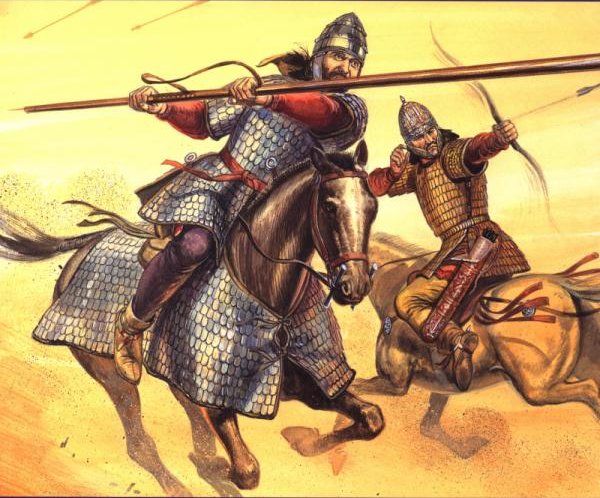
I think the movie can provide some good inspiration for the Peshwah. Although I see them closer to Scythians or perhaps middle eastern horseman cultures, the movie portrays a horseman culture as good as any with unusually shaped swords, strange rituals and brutality that would exist among any nomadic tribe.

I particularly enjoyed the part of the movie where the hero is taken into captivity and forced to go through a series of trials in order to win his freedom. This is something I could be tempted to copy and paste into my Blackmoor campaign, where the PCs are currently travelling through Peshwah lands looking for King Uther's heir.


-Havard

Thursday, September 8, 2011

The Divinity of Dragons

While D&D Dragons often are just big monsters to be killed in the last room of the dungeon, many mythologies connect dragons with the Gods. But Divine Dragons have always been a part of the game as well. OD&D had Tiamat and Bamut as Divine Dragons and BECMI D&D had the Dragon Rulers.  Dragonlance took the concept even further with having both Draconic Gods, but also mortal dragons as messengers of the Gods.

In my Blackmoor campaign I decided I wanted to explore this idea of humans viewing dragons as part of the divine. In this case, I decided to use the Peshwah Horsemen. Since I take some inspiration for the Peshwah from the Fremen in Frank Herbert's Dune series, I thought of the idea of using Dragons as a parallell to the Sand Worms of that series. The Fremen view the Sand Worms or Shai Hulud, as the manifestations of God; their actions being those of reverence, no matter how destructive. My idea was to make the Peshwah feel the same way about Dragons. Additionally I decided that the Peshwah would not distinquish between Good and Evil dragons. All dragons to them are sacred.

In the last session, my players took the concept even further than I had anticipated. One of the player characters had his arm destroyed by dragonfire, only to have it replaced by a clockwork arm. Upon learning this, another player, playing a Peshwah Monk of the Fallen Star (See Dave Arneson's Blackmoor D20 for details), declared that the fact that the character had his arm destroyed by a dragon was a mark of the divine. He believed that the character was Dragontouched, an individual meant for a greater purpose. Introducing the Dragontouched to the Peshwah clan of the Adiel, this character was met with reverence. This could be the thing that could help the PCs convince the Peshwah to join with Blackmoor in the ongoing War against the Egg of Coot. And the war is not looking good for Blackmoor right now. 


Image Source

-Havard

Thursday, January 13, 2011

Numeria: Pathfinder's Blackmoor

Pathfinder is doing really well these days. I am no expert on this game or its setting, Golarion, but as with everything from Paizo, the books look great. I was pleasantly surprised to discover the Golarion nation of Numeria, which seems to have alot in common with Blackmoor. I asked about this in a discussion over at the Piazza and it was pointed out to me that Golarion pays a great deal of homage to Greyhawk. Since Greyhawk has a Blackmoor, then Golarion should have one too.

A German D&D forum describes Numeria as a cross between Blackmoor and Expedition to Barrier Peaks. The most significant similarity is that during a cataclysmic event known as the Rain of Stars,

"a metal mountain fell from the sky and lit up the plains of Numeria, modern scholars believe it to be a vessel of some sort but that night it was a raging fireball."

This vessel from the stars, is apparently the source of the technological wonders which is an overarching theme to this nation. Furthermore, the capital of Starfall, shares many traits with Blackmoor's Starport and the Duchy of the Peaks in general. Numeria's ruler, the Black Sovereign, seems like a cross between the Iron Duke of Thonia and the Egg of Coot. The Black Sovereign is supported by technology oriented wizards and mechanical constructs. The people living outside the cities of Numeria are described in a way that reminds me of Peshwah. It is great to see that Dave Arneson's ideas were so strong that they keep showing up in new games and settings.


-Havard

Tuesday, December 14, 2010

Peshwah History

 I have been writing a bit on the Peshwah lately, talking about the different Peshwah Tribes and the kind of weapons and armor the Peshwah use. Now the time has come to present a part of Peshwah history:

It was the Great God, Hak, who had created the Horses and the Centaurs who lead the Peshwah into the promised grasslands which they named after their god. Hak had three sons who lived among the Peshwah in those early days, many centuries ago. The oldest was Hadeen, a proud hunter and master Archer. Calelrin was the middle brother, always in the shadow of Hadeen. Jealous of his brother, Calelrin plotted to kill the Peshwah leaders. Calelrin's Thonian assassins killed the chieftains Hurghast and Herutu and for this crime, Calelrin was banished to the demon realms. Hadeen, living on as a champion of the Peshwah was eventually invited to live among the Gods. The youngest son, Raelralataen also later achieved true godhood.

For a full timeline of the Peshwah, go here.

Image Source


-Havard

Thursday, December 9, 2010

Peshwah Equipment

The D20 Blackmoor Campaign guide provides a wide selection of equipment that is particular for the Peshwah. In the Riders of Hak Sourcebook, some of the items are designated especially to some of the individual tribes as favored weapons or armor.


Arbir
The Arbir is combination of a spear and sword, or a spear with a long sword like blade attached to one end.

Bulova
The Bulova is a wicked looking hand axe.

Grazer spear
This spear is an unusual looking weapon, similar to a spear, but with a crossbar near the spear point.

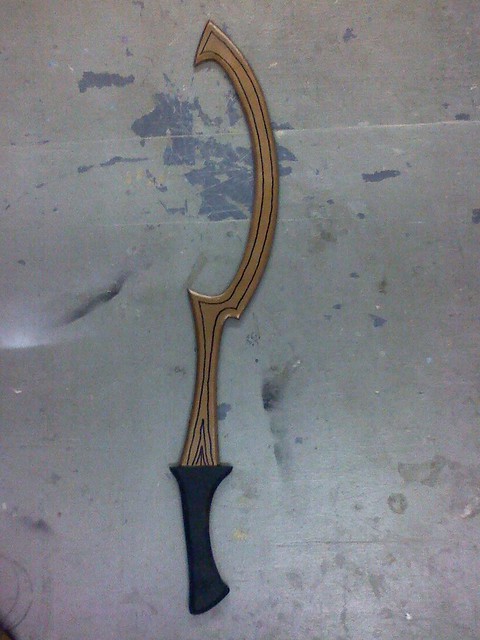
Sickle Sword
This is a sword with a long sickle like blade, almost like a scimitar, but with an even more pronouced curve of the blade.

Sickle Mace
This weapon looks like a pole with a sicke blade at one end and a mace at the other.

Prophet's Shield
A Shield constructed with bone framining and painted with the symbols of the God Yoosef.

Spidersilk Armor
A leather-like armor made from the special silk harvested by the Peshneath from spiders.


I have always liked the idea of different cultures using weapons characteristic for them. The Peshwa are different enough from the Blackmoorians and Thonians that it makes sense that they have different traditions when it comes to manufacturing such items. In a 3E campaign, the attributes for these weapons are given in the Campaign Sourcebook. If you are using BECMI or another version of Classic D&D, I would simply use damage and effects of the weapons they resemble and keep the visuals for flavour. They are too good ideas to not be used. Do you allow any exotic weapons in your campaigns?


Image Sources
Curved Sword
Weapons, DAB D20


-Havard

Wednesday, December 8, 2010

Peshwah Tribes


As some of you will know, I have been reading up on various sources on the Peshwah lately. The Peshwah are a horseman culture living to the south and west of Blackmoor. The D20 Blackmoor line defined the different tribes of the Peshwah in detail, but I could never get a clear picture of which tribe belonged where and was associated with what. Above is a map by DaveL, which I have modified to show where the different tribes are commonly found. Below is a quick run down of the tribes. This is a work in progress though, so feel free to comment and criticize what I have so far:


Adiel
The Adiel aret he archetypical Peshwah. They are the most numerous tribe and know to be master horsemen. Many Adiel prefer the Sickle sword in combat.

Briela (Not on map)
The Briela are a kind of Gypsies, travelling all over the world. They are known as storytellers and diplomats. For centuries they have devoted their lives questing for the Bow of Hadeen.

Bortai
The Bortai are the most savage of the Peshwah, living like the horsemen did in the earliest days. Interestinly they are not xenophobic however. And due to Peshwah na Shepro, they have formed an alliance with Blackmoor. Man Bortai use a special hand axe called the Bullova.

Falleem
Unlike most other Peshwah, the Falleem are city dwellers.  They are a religious lot and good merchants. Many Falleem use scimitars in battle.

Irfat
The Irfat are grim warriors. They see themselves as “The Black Riders” of the religious texts. This tribe lives for war. They often fight with twin short swords. 

Leron
The Leron is the tribe guarding the border of the Valley of the Ancients. Due to their proximity to the Valley, they have access to many strange items. They are paladin-like guardians. Many join the order of the Dragon Knights, a group of warriors with unique magical abilities. Some of their warriors use Greatswords in battle.

Ornidri
The Ornidri are the best archers among the Peshwah. They have often ventured into the lands of Ten. They are good horsemen, but also breed hounds to be used for hunting.

Peshneath
This tribe have abandoned the way of the horse and are village dwellers. They are excellent craftsmen and known to produce wonderful items made of spider silk. Peshneath warriors sometimes use a weapon called the Arbir. It looks like a cross between a sword and a spear.

Qulaam
The Qulaam are riverfolk and fishermen, living near the root river. They distrust anyone other than the Peshwah. They have giant weasel companions

Somhak
The Somhak are the traditional leaders of the Peshwah. They are master strategists and their word carries great weight among the other tribes. Hadeen was a Somhak before he ascended to the Godly realms.

Sufz
The Sufz are the spiritual leaders of the Peshwah. Many are druids.  They are completely nomadic and have no permanent settlements at all. They are often seen wearing metal skull caps in battle.

Zah
Zah are known to be the seers and magic users of the Peshwah. They live near the mysterious Salt Tower.  Their leaders are women. In battle they often use a special kind of shields known as Prophet’s Shields.  


-Havard

Thursday, November 4, 2010

[Races] Kurgans


Two centuries ago, Calelrin, God of Murder and Deceit lead a tribe of Peshwa out of the Plains of Hak, on a long journey south. Over the years, the Krugel tribe became very different from their Peshwa cousins. Under Calelrin’s influence they became a cruel warrior people, strangers to words like mercy or kindness. They are horseman nomads living on grassland steppes in distant lands south of Blackmoor. These days they are sometimes used as elite cavalry by the Thonian Empire.

Personality
Kurgans are a brutal people, their personality shaped by the harsh life on the steppes. They are infamous for their cruelty and reputed to toss children into pits full of starved dogs, and watch them fight for the meat for amusement. They practice animal husbandry, keeping horses, cattle, pigs, sheep and goats. They prefer to ride geldings, their main herds being kept wild under stallions, and controlled through the mares which were hobbled near the settlements and milked regularly

Physical Description
Kurgans are taller than average humans. They have gray eyes and dark hair and hard features. Unlike their browned skinned Peshwa cousins, their skin is pale. They often dress in dark colors and often decorate their armor with the bones of horses, including the characteristic jaw bones attached to their helmets.

Alignment
Kurgans are usually Neutral Evil. Good Kurgans will be outcasts from their people, and will be viewed with suspicion in other lands. Few live very long.

Lands
The realms of the Kurgans are now part of the Thonian Empire. Their lands are typically flat steppe grasslands, near wooded areas and watercourses. There are mixed forests of oak, birch, fir, beech, elder, elm, ash, aspen, apple, cherry and willow. Wildlife in these lands include aurochs, elk, boar, wild horses, wolves, fox, beaver, squirrels, badgers, hare and roe deer. These lands are also known to be home to a large lizard known as the Sheltopufik. It is not venomous, is often six feet long; it moves about with erect head and breast, and when pursued defends itself by darting against the horse and his rider. The Kurgans live semi-nomadic lives, but the occasional hill-fort and village can be seen when travelling through these lands.

Relations
The Kurgans have become subjugated by the Thonian Emperor, but enjoy relative freedom within the Empire. The Kurgans found that they were soon gaining a reputation for being great mercenaries. They are frequently employed as elite Cavalry by the Thonians. Some are even deployed on the Thonian Rand near Blackmoor. The Peshwa view the Kurgans as an abomination and fear them as do most others who have heard of this people.

Religion
Kurgans follow the Peshwa pantheon, but hold Calelrin the God of Murder Deceit above the other gods. Calelrin’s murder of his brother Hadeen is seen as a holy act to the Kurgans and many Kurgan warriors have tried to seek out the place where Hadeens body fell to worship the cruelty of their God.

Language
Kurgans speak a dialect of the Peshwa language. Most also speak Thonian.

Names
Kurgans go by their first name and a clan name.

Male Names
Agah, Akhun, Bahri, Cengiz, Duyal, Firat, Haldun

Female Names
Asu, Ayfer, Berfu, Cennet, Desen, Esma, Izel

Adventurers
Kurgans who travel the world are often mercenaries. Most adventurers are Fighters or Barbarians. High level Kurgans can become Dragon Knights, in spite of their evil alignment.

Discussions on this topic


-Havard

Mystara Could Return Says WotC's Bilsland

  In a recent interview with Ted from NerdImmersion, WotC's head of D&D Greg Bilsland was asked about whether WotC would consider to...